USLA Home Remodeling logo featuring a blue roof with green vertical stripes and a small blue window, accompanied by the company name and phone number 1-800-508-0259. The design represents residential home improvement and remodeling services. This logo serves as the primary branding for the company's remodeling business.
Investor & Owner Strategies · Los Angeles

Multi-Family ADU Construction in Los Angeles — Investor & Owner Strategies

CSLB #1071589Regulatory Feasibility FirstLA DBS & LA County DPW
It Depends on Unit Count

Multi-Family ADU Rules in Los Angeles Depend on Existing Unit Count and Applicable State Law

The number of ADUs you can add to a multi-family property in Los Angeles is not fixed — it depends on how many units already exist.
A 2-4 unit multi-family property — a residential property with two to four separate dwelling units — is eligible for ADU additions under current California law. The rules governing those additions differ from single-family lot rules, and they are layered. AB 2221 (Assembly Bill 2221), effective January 2023, expanded ADU allowances and reduced setbacks on multi-family lots. Under that framework, owners of properties with existing multi-family housing may add detached ADUs equal to 25% of the existing unit count, with a minimum of one allowed regardless of the math.
That is the baseline. Density bonus provisions — California law allowing more units than base zoning permits when affordable housing components are included — can increase that number further on qualifying properties. SB 9 (Senate Bill 9), which allows eligible single-family lots to be split into two parcels with up to two units per parcel, operates on different criteria and may or may not apply depending on the parcel’s original classification.
Getting these overlapping rules wrong at the permit application stage means submitting drawings for a unit count LA DBS will not approve. The application comes back with corrections. The review clock restarts.
Both Jurisdictions

We Build ADUs on 2-4 Unit Properties Across the City of LA and Unincorporated County

US LA Home Remodeling Inc has direct project experience on multi-family ADU construction in both City of LA and unincorporated Los Angeles County jurisdictions.
This distinction matters more than most investors realize. A duplex on a street in Reseda operates under City of LA zoning. A duplex three blocks away — on a parcel inside unincorporated LA County territory — operates under LA County DPW review. The applicable ADU allowances, setback rules, and permit review timelines can differ significantly between those two properties even though they look identical from the street.
US LA Home Remodeling Inc, holding CSLB License #1071589, manages multi-family ADU projects across Greater Los Angeles with direct familiarity across both jurisdictional boundaries. We file with LA DBS for City of LA parcels. We file with LA County DPW for unincorporated parcels. The permit track is identified before design begins — not discovered partway through plan check.
A modern kitchen remodel featuring white cabinetry, black stainless steel appliances, and a striking black marble island with fluted wood paneling and seating for two. The space includes recessed lighting, a gray tile backsplash, light wood flooring, and a contemporary design with a vase of dried pampas grass and decorative accessories on the island.
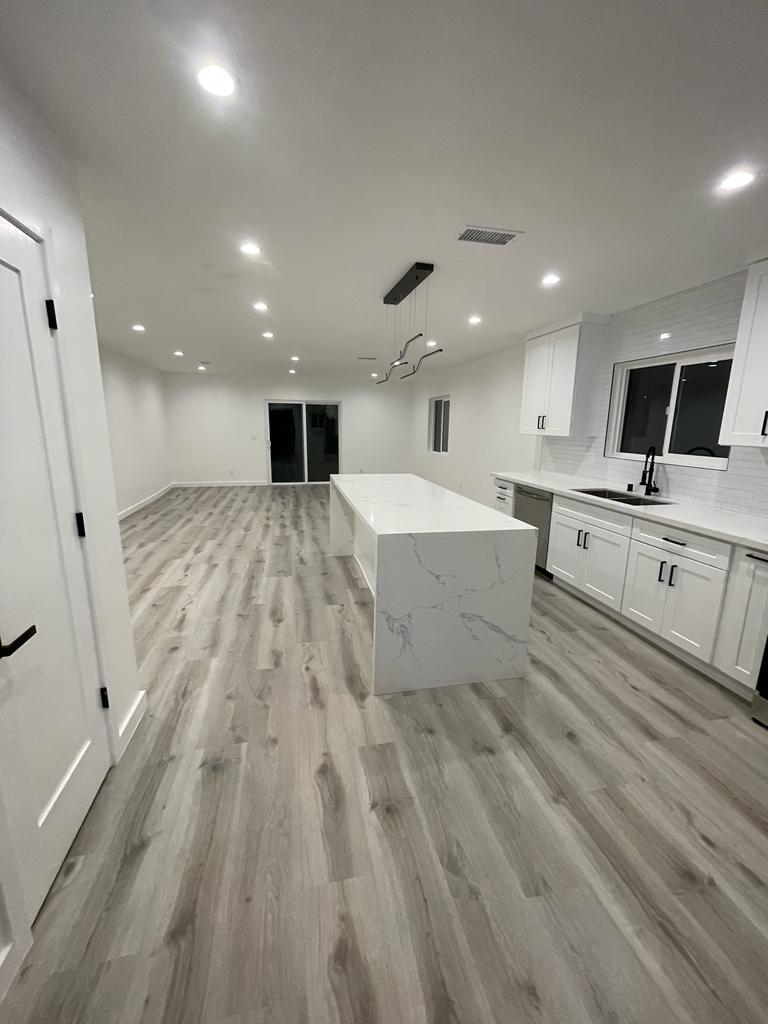
A modern, newly remodeled kitchen and living space featuring white cabinetry, a large white marble-look island, and gray wood-look vinyl plank flooring throughout. Recessed lighting is installed in the ceiling, and the open concept design connects to a spacious living area with glass doors visible in the background. White subway tile backsplash and stainless steel appliances complete the contemporary, clean aesthetic of this residential renovation project.
Which Law Governs?

Which Law Governs Your Multi-Family ADU — SB 9, AB 2221, or Both?

The answer depends on your property’s original classification, existing unit count, and lot conditions — confirmed before a single drawing is commissioned.
I’m Uzi Ezra, Founder and CEO of US LA Home Remodeling Inc. I’ve reviewed enough multi-family ADU permit applications in Los Angeles to know where this process breaks down. Investors arrive having already gotten a rough layout from an architect. The layout assumes AB 2221 applies. Then a site review reveals the parcel was originally classified differently, or it sits in an overlay zone that changes the setback allowances, or the lot size triggers a different density calculation. The drawings do not match the legal allowance. The project returns to square one — with an architect’s invoice already paid.
Here is how we approach it instead.
SB 9 applies to properties that were originally single-family lots and qualify for a lot split under the statute’s conditions — urban infill location, no historic designation, no fire hazard override, among others. When SB 9 applies, it enables up to two housing units per resulting parcel, effectively allowing up to four units on what was previously a single-family lot. The key phrase is “previously a single-family lot.” A property already classified as multi-family residential does not use the SB 9 framework.
AB 2221 governs most of the multi-family ADU work we manage. It clarified that owners of multi-family residential properties may add detached ADUs equal to 25% of the existing unit count, with at least one permitted regardless. On a duplex, that means one detached ADU is allowed by right. On a four-unit building, that is one detached ADU. On an eight-unit building, two. The unit count calculation is straightforward. What is not always straightforward is whether the lot conditions — setbacks, easements, utility access — support placement of that detached unit where the owner envisions it.
The property valuation impact of these additions is real. Adding a permitted ADU to a multi-family property in Los Angeles increases the income-producing potential of the parcel — which directly affects how lenders and buyers assess its value. A permitted, occupied ADU with documented rental income is a different asset than an empty lot with theoretical ADU potential.
— Uzi Ezra, Founder & CEO, US LA Home Remodeling Inc
Feasibility First

Property-Level Feasibility Review Before a Single Drawing Is Commissioned

Every multi-family ADU engagement at US LA Home Remodeling Inc begins with a regulatory feasibility review — not a floor plan.
The feasibility question is not simply “can I build?” It is “which law gives me the right to build, and under what exact conditions does that right apply to this parcel?” Answering that second question requires examining the property’s recorded use classification, existing unit count, lot dimensions, applicable setback rules, and whether any overlay zone or density bonus condition changes the calculation.
We conduct that review before design begins. The output is a confirmed unit count, confirmed size limits, and confirmed setback rules — all specific to the parcel. Drawings are produced once, to the right standard, rather than revised after a plan check rejection restarts the clock.
Separate metering — installing an individual electrical and/or gas meter for each dwelling unit — is coordinated at this stage. It is required for independent utility accounts on most LA multi-family ADU projects. LADWP coordination is part of our project management scope, not an afterthought.
Use ClassificationUnit CountSetback RulesSeparate Metering
Our Process

Our Multi-Family ADU Process: Regulatory Review, Permit Filing, and Separate Metering

Our process is built around one principle: the regulatory layer is confirmed before any money is spent on design.
Here is the sequence on every multi-family ADU project:
1

Regulatory Feasibility Review

We identify the applicable state statute — AB 2221, SB 9, or density bonus — confirm the allowable unit count and size limits for the specific parcel, and map the setback and placement rules that govern where the ADU can go.
2

Site Assessment

We confirm utility connection points, easements, drainage conditions, and any overlay zone restrictions before a floor plan is sketched.
3

Permit Application

We file with the correct jurisdiction — City of LA DBS or LA County DPW — with drawings produced to the confirmed standard.
4

Separate Metering Coordination

LADWP electrical service is coordinated under our contract. Utility scheduling is tracked as a project milestone.
5

Construction

All trades managed under CSLB License #1071589. One contractor, one permit, one inspection sequence.
6

Certificate of Occupancy

The final deliverable is a legally permitted, separately metered dwelling unit ready for occupancy and rental documentation.
Income-Producing Units

Build Income-Producing Units on Your Los Angeles Multi-Family Property With Legal Permits

A multi-family ADU built and permitted correctly is a documentable income asset — one that holds up at refinancing, appraisal, and sale.

Permit Filing and Plan Check

Once the feasibility review is complete, permit drawings are filed with the correct reviewing agency. For City of LA parcels, that is LA DBS. For unincorporated county parcels, that is LA County DPW. We prepare the application to the confirmed regulatory standard so that plan check review addresses real engineering questions — not unit count corrections that should have been resolved before submission.

Construction and Inspections

Construction follows the approved plans. Rough inspections are scheduled at the correct stages — before walls close, before systems are covered. Final inspection closes the permit. All of this happens under one licensed contractor relationship. CSLB License #1071589 covers the full scope: structural, electrical, plumbing, and mechanical.

Rental Documentation and Property Valuation Impact

A permitted ADU with a certificate of occupancy can receive its own mailing address through the LA Bureau of Engineering. It can carry its own utility account. It can generate documented rental income that a lender counts when the property owner refinances or sells. The permitted unit adds to the property’s income-producing record — which is precisely what investment property in Los Angeles is built to do.
Areas We Serve

Multi-Family ADU Construction Locations We Cover in Greater Los Angeles

US LA Home Remodeling Inc serves multi-family ADU projects across the full Greater Los Angeles service area.
We work across the City of Los Angeles, the San Fernando Valley, and surrounding LA County communities. We file with LA DBS for city parcels and with LA County DPW for unincorporated territory. If your investment property is in Greater Los Angeles, we can confirm the applicable jurisdiction and permit track before the first consultation ends.
City of Los AngelesSan Fernando ValleyResedaTarzanaLos Angeles County
Next Step

Investment Property in LA? Let Us Map the ADU Options for Your Specific Parcel

The right starting point is a property-level review — not a general conversation about what ADUs are allowed in LA.
Call 800-508-0259 or email info@uslaremodeling.com to schedule a multi-family ADU feasibility review. Have your property address and current unit count ready. We will identify the applicable state statute, confirm the allowable ADU count and size limits for your parcel, and explain what the permit timeline looks like for that specific property.
No drawings required. No fees upfront. A direct conversation about what your investment property is eligible for under current California law.
info@uslaremodeling.com  ·  5530 Corbin Ave, Tarzana, CA 91356
FAQ

Investor Questions About Multi-Family ADUs in Los Angeles

It depends on how many units already exist. Under AB 2221, effective January 2023, owners of multi-family residential properties may add detached ADUs equal to 25% of the existing unit count, with a minimum of one allowed regardless of the math. On a duplex or a four-unit building that’s one detached ADU; on an eight-unit building, two. Density bonus provisions can increase that number further on qualifying properties.

SB 9 applies to properties that were originally single-family lots and qualify for a lot split — it enables up to two housing units per resulting parcel, effectively up to four units on what was previously a single-family lot. A property already classified as multi-family residential does not use the SB 9 framework. AB 2221 governs most multi-family ADU work and sets the 25%-of-existing-unit-count allowance. Which one applies depends on the parcel’s original classification.

A duplex under City of LA zoning goes through LA DBS. An identical-looking duplex a few blocks away on an unincorporated parcel goes through LA County DPW. The applicable ADU allowances, setback rules, and permit review timelines can differ significantly. We identify the permit track before design begins rather than discovering it partway through plan check.

Separate metering — an individual electrical and/or gas meter for each dwelling unit — is required for independent utility accounts on most LA multi-family ADU projects. We coordinate LADWP electrical service under our contract and track utility scheduling as a project milestone, so it’s part of the project management scope rather than an afterthought.

The feasibility question isn’t simply “can I build?” — it’s “which law gives me the right to build, and under what exact conditions does that right apply to this parcel?” Investors who start with an architect’s layout assuming AB 2221 applies can find the drawings don’t match the legal allowance once a site review is done, sending the project back to square one with the invoice already paid. We confirm unit count, size limits, and setback rules before drawings are produced.

Adding a permitted ADU increases the income-producing potential of the parcel, which directly affects how lenders and buyers assess its value. A permitted ADU with a certificate of occupancy can receive its own mailing address through the LA Bureau of Engineering, carry its own utility account, and generate documented rental income a lender counts at refinance or sale — a different asset than an empty lot with theoretical ADU potential.